
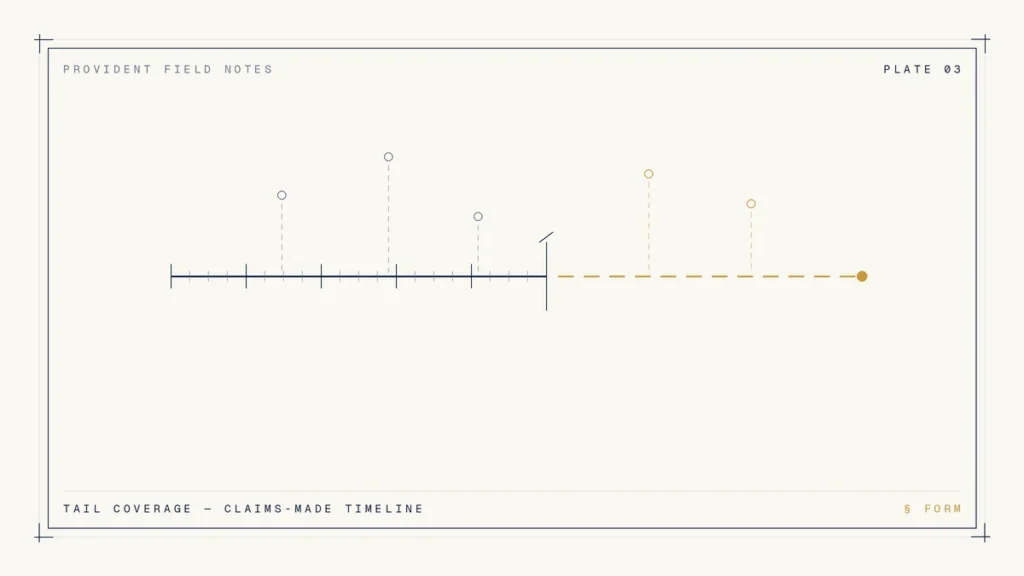
Professional liability has a time-travel problem: you do the work now, and the claim arrives in three years. Claims-made insurance is the industry’s solution, and three dates control whether it works for you.
How claims-made coverage works
A claims-made policy covers claims made against you during the policy period — not claims about work done during it. Your 2026 policy responds to the claim filed in 2026 about work you did in 2023, provided one thing: the work happened after your retroactive date.
The retroactive date: your coverage’s birthday
The retro date is the earliest work date your policy reaches. Keep coverage continuous and the retro date rides along at each renewal, extending protection over every year of past work. Let coverage lapse — or accept a new retro date when switching carriers — and past work goes uninsured, permanently. When changing carriers, the non-negotiable ask is prior-acts coverage matching your existing retro date.
Tail coverage: protection after the policy ends
When you retire, sell, or close, your claims-made policy stops — but claims from past work keep their own schedule. An extended reporting period (“tail”) keeps the door open: claims made after cancellation, about covered past work, can still be reported. Tails are typically priced as a multiple of your final premium (one to three times, depending on length), and many carriers include free tail options after several years of continuous coverage at retirement. Professions with long claim latency — accountants, architects and engineers, attorneys — should treat the tail as part of retirement planning, not an afterthought.
The three habits that make claims-made work
Never lapse. Even a short gap can break continuity. Report early. Claims-made policies require prompt notice — report circumstances that might become claims, which locks them to today’s policy. Guard the retro date. Cheaper premium with a reset retro date is almost never a good trade. Questions about your dates? We read policies for a living.
Leave a Reply