
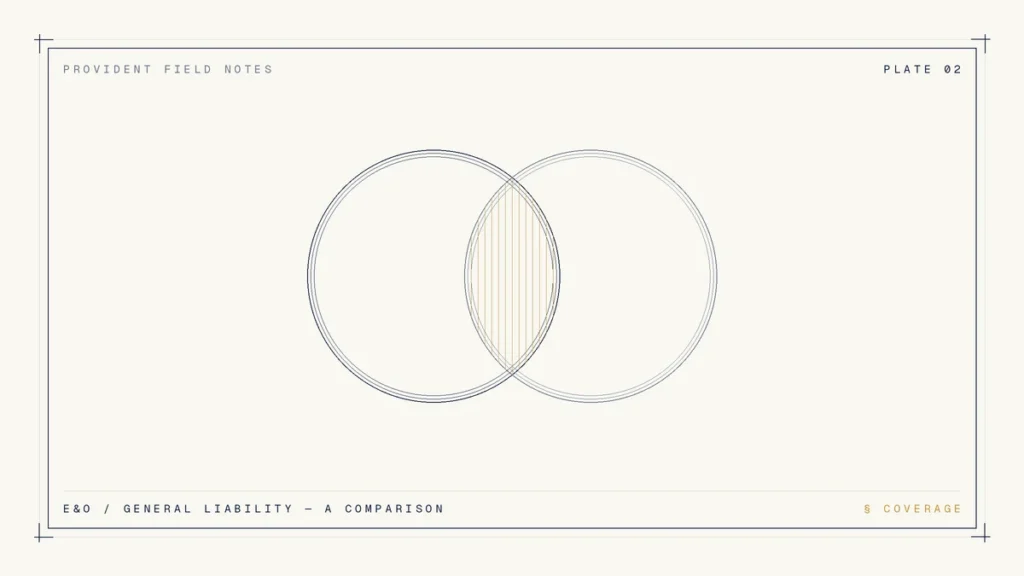
The two policies every professional hears about first — general liability and professional liability (E&O) — divide the world cleanly, and confusing them is the most common coverage mistake small firms make. Here’s the split.
General liability: the physical world
General liability covers bodily injury and property damage connected to your business: a client trips over your bag, your employee damages a client’s conference room, you knock a server rack over during a site visit. It’s the certificate landlords and venues demand, priced cheaply for office-based professionals because the physical risk is modest.
Professional liability: the professional world
E&O covers financial-loss claims from your services: the missed deadline, the calculation error, the advice that didn’t perform, the deliverable that fell short of the engagement. No one gets physically hurt in an E&O claim — the injury is to a balance sheet, and GL policies expressly exclude it.
Why you can’t substitute one for the other
GL forms exclude professional services; E&O forms exclude bodily injury and property damage. The exclusions interlock by design — each policy assumes the other exists. A consultant with only GL is uninsured for their actual work product; a consultant with only E&O can’t sign most office leases.
What a complete small-firm program looks like
The standard stack: a business owners policy (GL + property + business interruption) as the chassis, E&O as the professional layer, cyber if you hold client data, and workers comp the day you hire. Client contracts will name each policy separately with required limits — usually $1M per occurrence/claim.
Not sure which side of the line your risk lives on? That’s literally our job. Get quotes or ask us.
Leave a Reply